Reference Points: on retranslating eyes
In my artistic practice, I use simultaneous interpretation to explore the inevitable‘delay’ that occurs when m […]

2026.1.28[wed] - 2026.2.1[sun]
18:00‒21:00(wed,thur) |12:00‒21:00(fri,sat,sun)
Admission: ¥400(with tea)

In my artistic practice, I use simultaneous interpretation to explore the inevitable
‘delay’ that occurs when meaning moves between languages. By focusing on this gap, I
question the assumption of simultaneity in global contemporary art and propose instead
multiple, overlapping ‘now(s),’ where artistic, historical, and cultural temporalities coexist.
My work challenges the universality of the linear art-historical sequence—from Realism to
Contemporary—and reimagines art history as plural, asynchronous temporalities shaped
by delays.
Moving beyond a conceptual approach, I now ground this inquiry historically by
examining how such temporal gaps were institutionalized through art education and
standardized ways of seeing. This stems from my dual art education background: in
Korea, I was taught European realism as a technical discipline, while in the Netherlands,
creativity and individuality were emphasized. The realism I learned in Korea was European
in origin but transmitted via Japan—a key mediator of modernity in East Asia—even as
Europe itself had already moved from it. In this process, Japan functioned as both
translator and transmitter of modernity, entangled with projects of enlightenment and
colonial domination.
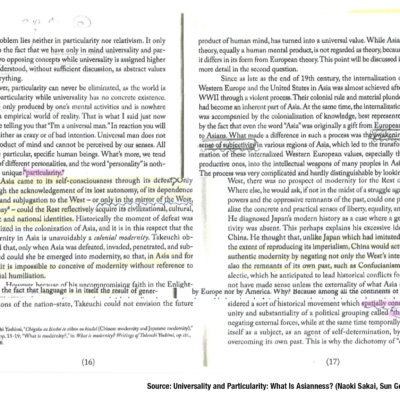
I approach Japan and modernity not as fixed historical stages, but as intertwined
experiences. In Asia, modernity was embraced as progress—a desire that ‘we’
internalized—yet its shadow, colonialism, reveals the contradictions embedded within
that very notion of progress. Rather than treating modernity as a completed historical
phase, this project understands it as an ongoing condition shaped through translation
and adaptation. Through this lens, I trace how visual art education and institutional forms
of translation have shaped not only artistic representation, but also the artist’s sense of
self. This question—whether and how I can become theoretically critical of the aesthetic
sensibilities I have already internalized—continues to guide my practice.
January 31st (sat) 19:00
Minsun Kim‘s farewell party + Art Center Ongoing 18th Anniversary
Admission: 1000 yen (with light catering+one drink)
In my artistic practice, I use simultaneous interpretation to explore the inevitable‘delay’ that occurs when m […]